
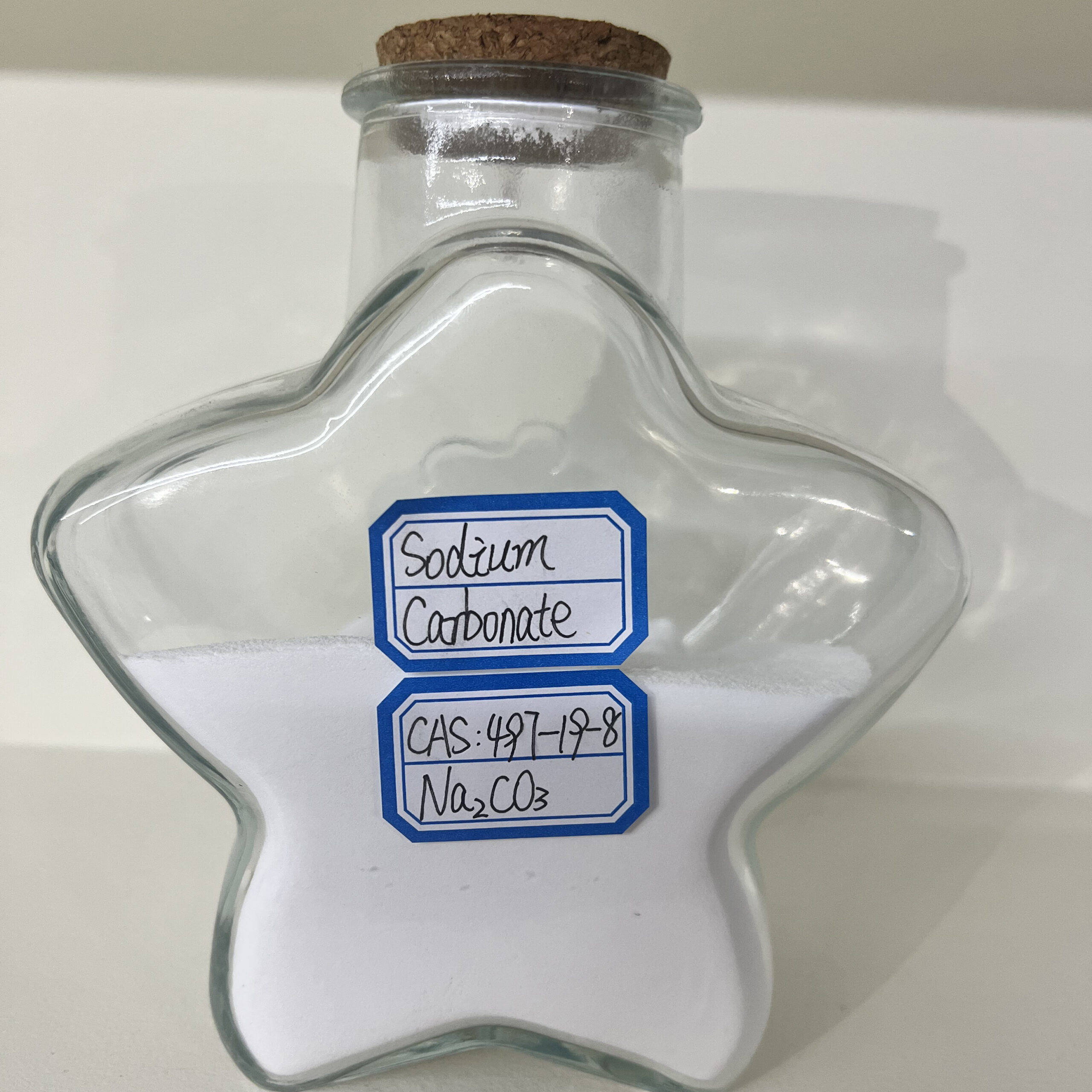
Specification Datasheet
| Product Name | Sodium Carbonate | ||||
| Appearance | Crystalline Powder | ||||
| Grade | Food Additive | Industrial grade | |||
| Total Alkalinity Dry (ω/%) | 99.2 | 99.4 | 99.2 | 98.8 | 98.0 |
| Total Alkalinity Wet (ω/%) | 97.9 | 98.1 | 97.9 | 97.5 | 96.7 |
| CAS No.: | 497-19-8 | ||||
| EINECS | 231-861-5 | ||||
| Chemical Formula | Na2CO3 | ||||
| Melting Point | 851℃ | ||||
| Boiling Point | 1600℃ | ||||
| Molecular Weight | 105.99 | ||||
| Density | 2.532 g/cm³ | ||||
Application
- The glass industry is the largest consumer of soda ash, requiring 0.2 tons of soda ash per ton of glass produced. It is primarily used in the manufacture of float glass, cathode-ray tube (CRT) glass bulbs, and optical glass.
- Used in chemical and metallurgical industries. The use of dense soda ash reduces airborne dust, lowers raw material consumption, and improves working conditions; it also enhances product quality, mitigates the corrosive effect of soda dust on refractory materials, and extends the service life of furnaces.
- Used as a buffering agent, neutralizing agent, and dough improver in pastries and flour-based products; applied in appropriate quantities according to production needs.
- Used as a detergent (e.g., for wool scouring), in bath salts and pharmaceutical applications, and as an alkalizing agent in leather tanning.
- Used in the food industry as a neutralizing agent and leavening agent—for instance, in the production of amino acids, soy sauce, and flour-based foods like steamed buns and bread. It can also be prepared as an alkaline solution added to wheat-based foods to enhance elasticity and extensibility. Sodium carbonate is also used in the production of monosodium glutamate (MSG).
- Specialized reagent for color televisions.
- Used in the pharmaceutical industry as an antacid and an osmotic laxative.
- Used in chemical and electrochemical degreasing, electroless copper plating, aluminum etching, electrolytic polishing of aluminum and its alloys, chemical oxidation of aluminum, sealing after phosphating, inter-process rust prevention, electrolytic stripping of chromium plating and chromium oxide films, and as a component in electrolytes for pre-copper plating and the plating of steel and steel alloys.
- Used in the metallurgical industry as a smelting flux, a flotation agent for mineral processing, and a desulfurizing agent in steel and antimony smelting.
- Used as a water softener in the printing and dyeing industry.
- Used in the leather industry for degreasing raw hides, neutralizing chrome-tanned leather, and increasing the alkalinity of chrome tanning liquors.
- Serves as a primary standard for the standardization of acid solutions in quantitative analysis. Used in the determination of aluminum, sulfur, copper, lead, and zinc; the testing of glucose in urine and whole blood; as a flux for silica analysis in cement; and in metal metallographic analysis.
Packaging
25KGS/BAG or 50KGS/BAG or 1000KGS/BAG
Storage
- Environmental conditions: Store in a cool (avoid high temperatures), dry (prevent moisture absorption and caking), and well-ventilated warehouse; keep away from light.
- Container selection: For solids, use glass bottles with rubber stoppers (do not use ground-glass stoppers to prevent sticking); for large-scale industrial use, use woven bags or bulk bags (FIBCs) with moisture-proof plastic liners, ensuring a tight seal.
- Incompatibilities: Must be stored separately from acids and ammonium salts (e.g., ammonium chloride, ammonium sulfate); strictly avoid mixed storage. Keep away from metal products to prevent corrosion and rusting.